


The Climate target of the Green Tripartite Agreement
The analysis focuses on the potential for technical emission reductions from livestock housing and manure storage facilities. It also supports the DCCC’s previous assessments, stating that there is a significant risk that the Green Tripartite Agreement will not deliver the expected reductions by 2030. This is because the effects of the available measures are either fully utilized, uncertain, or delayed. Thus, these potentials are therefore insufficient for the agricultural sector to achieve the agreement’s climate targets, leaving further reduction dependent on structural and technical changes in livestock production. Technical emission reductions and structural changes are interrelated and should be considered in combination. A tax on greenhouse gas emissions is a cost-effective way to drive both types of emission reductions simultaneously. The tax can be supplemented by other policy measures that support the same direction of transition.
Main conclusions
An additional 1.4 million tonne of CO2e reductions may be needed to meet the climate targets of the Green Tripartite Agreement in 2030
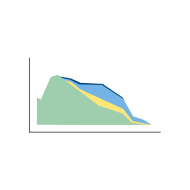
The DCCC assesses that an additional 1.4 million tonne of CO2e reductions may be needed to meet the Green Tripartite Agreement’s target of reducing agricultural emissions by 2.2 million tonne of CO2e in 2030. There are two reasons for this. First, the agreement includes a reduction gap of 0.4 million tonne of CO2e from the outset, which has yet to be addressed by a specific plan. Second, there is considerable uncertainty as to whether the planned reductions from the livestock emissions tax, the use of the feed additive Bovaer, use of pyrolysis, regulation of fertiliser and lime use, efforts to rewet carbon-rich lowland soils, and afforestation will be realised by 2030.The DCCC assesses that the planned policy measures could collectively deliver up till 1.0 million tonne of CO2e fewer reductions than assumed in the Green Tripartite Agreement. As a result, the total reduction requirement could reach 1.4 million tonne of CO2e in 2030.
The climate target of the Green Tripartite Agreement's must be achieved through emission reductions in livestock production
Additional emission reductions to ensure that the climate target of the Green Tripartite Agreement is met cannot realistically be achieved through increased rewetting of carbon-rich lowland soils, reductions in nitrous oxide emissions from agricultural land or reductions in enteric fermentation emissions through the use of Bovaer. This is because the measures already planned towards 2030 are delayed or uncertain. The remaining reductions must therefore come from livestock production, both through technical measures in manure management in livestock housing and storage facilities and through structural changes such as changing the composition in types of livestock, fewer animals, and changes in production methods and livestock housing systems.
The potential for technical emission reductions in livestock production is limited
Existing technologies for reducing emissions from manure management in livestock housing and storage facilities could potentially deliver reductions of approximately 0.8 million tonne of CO2e in 2030. This corresponds to 13 per cent of total emissions from livestock production in 2030. The estimates are optimistic, as it assumes that technologies can be applied to all manure, be implemented by 2030, and that their effects have been documented. The potential achieved in practice could therefore be considerably lower.
Higher livestock emissions taxes primarily strengthen incentives for structural transition
The planned livestock emissions tax is scheduled to take effect in 2030 and is intended to encourage both technical and structural transition among livestock producers. The tax will be set at DKK 300 per tonne of CO2e in 2030, increasing to DKK 750 per tonne in 2035, with a basic deduction of 60 per cent. No trajectory for the progression of the tax has been agreed upon beyond 2035. The DCCC’s analysis shows that the livestock emissions tax could give incentives for technical emission reductions of approximately 0.6 million tonne of CO2e in 2030. In addition, the tax provides incentives for structural transition, as demonstrated by previous analyses of the livestock emissions tax. This potential overlaps with the expected reduction of 0.4 million tonne of CO2e from the livestock tax under the Green Tripartite Agreement. Therefore, only part of the estimated reduction potential of 0.6 million tonne of CO2e can contribute to closing the potential reduction gap of approximately 1.4 million tonne of CO2e in 2030.
The technical emission reductions incentivised by the livestock emissions tax correspond to 72 per cent of the calculated technical potential. Higher tax rates would therefore primarily strengthen incentives for structural transition, as most technical emission reduction measures are expected to be effectuated at the planned tax rate. In addition to the specific design of the tax, other regulations affecting agricultural production may also encourage structural transition. These include among other regulations concerning nitrogen, protection of groundwater from pesticide leaching, animal welfare, and biodiversity.
A uniform basic deduction can increase the impact of the tax
The planned livestock emissions tax includes a basic deduction of 60 per cent, calculated using a historical average reference emission level per animal. This means that only emissions above this level are taxed. The basic deduction is numerically fixed, allowing producers to reduce their emissions over time and potentially avoid paying the tax altogether. The design of the base deduction is therefore important. A uniform definition covering broad livestock categories, such as dairy cattle and slaughter pigs, ensures that differences in emissions between animals are reflected in tax payments. This strengthens incentives to choose lower-emitting animals and production methods. A more differentiated design, for example differentiating on breed or production method within each livestock category, would instead give higher-emitting animals larger deductions. This would narrow the differences in tax payments and weaken incentives for structural transition.
Early structural transition could reduce the risk of misinvestments
Given the limited technical potential for reducing emissions, structural transition in livestock production will also be necessary to achieve the long-term climate targets. Such a transition may involve changing the composition in types of livestock, finer animals, and changes in production methods and livestock housing systems. New investments in livestock housing and manure storage technologies on the short term could therefore make the structural transition more expensive. This supports the case for agriculture to begin a structural transition now that also contributes to achieving the long-term climate targets.
Technical and structural transition have different implications for societal considerations
Investments in technology will generally leave existing production methods unchanged and therefore have relatively limited negative impacts on the agricultural sector's total economic performance and derived employment effect, although this depends on the size of the investment. However, such investments offer relatively few benefits in relation to other societal concerns. Structural transition in livestock production, by contrast, could deliver substantial benefits for biodiversity, the aquatic environment, and groundwater. However, it requires more extensive changes and investments in the sector, which may be difficult and costly to implement in the short term. The potential benefits of structural transition, such as biodiversity, will however not materialise automatically, but require additional regulation, as well as alignment between policies.
The government's food strategy could play an important role in supporting structural transition
The Danish government is proposing a food strategy aimed at steering Danish agriculture towards, among other things, increased production of fruit, vegetables and pulses, as well as a greater share of organic production. For the strategy to have the intended effect, it is important to establish clear targets that provide a consistent direction for the development of agriculture both before and after 2030. The strategy should support farmers in transitioning to different production methods, with a particular focus on expanding climate-friendly production. The government could draw inspiration from other EU countries, particularly the Netherlands and Germany, which are working with clear targets for food production that address both production and consumption.
Recommendations:
The livestock emission tax should be included in the 2027 revisit
The livestock tax should be included in the 2027 revisit of the Green Tripartite Agreement, to establish a comprehensive plan to ensure the climate target to be met by 2030. According to the Green Tripartite Agreement, the livestock tax is to be implemented in 2030 and revisited in 2032. However, it is important to consider the livestock tax already now in order to develop a comprehensive plan for the agricultural sector to meet the climate target of the Green Tripartite Agreement by 2030. The Danish Council on Climate Change (DCCC) therefore recommends that the government include the livestock tax in the 2027 review to help close the reduction gap under the Green Tripartite Agreement in 2030 and beyond. This will also provide clarity for the future structural transition of livestock production. Including the livestock tax at this stage entails decisions on the specific design of the tax base and basic deduction, as well as determining the tax rate after 2035.
An appropriate tax design is important for achieving both the climate targets of the Green Tripartite Agreement and Denmark's national climate targets and for enabling farmers to plan their future production activities in line with the long-term climate targets. It is also necessary to reduce the risk of making technical investments today that may help meet short-term targets but prove insufficient in the longer term, making the long-term transition more expensive.
The design of the livestock tax should ensure sufficient emission reductions. When determining the specific design of the tax, the government should ensure that it achieves the greatest possible overall reduction in greenhouse gas emissions, including by applying a relatively uniform basic deduction across broad livestock categories. A more differentiated basic deduction, for example based on breed or livestock housing system within livestock categories, would reduce some of the differences in tax payments between high- and low-emission animals, thereby weakening the incentive to choose animals and production methods with lower emissions.
Regulation before and after 2030 should encourage structural transition
The government should ensure that the overall regulatory framework supports structural changes in livestock production. Public subsidies funded by Denmark or the EU can either make it easier to restructure livestock production or reduce the cost of maintaining existing production methods. There are several examples of subsidy schemes that may work against each other. One is the new targeted nitrogen regulation, which introduces subsidies targeted at farms using livestock manure, as these farms may be particularly affected by the regulation. Another is the slaughter premium, which provides a subsidy for each heifer, bull or steer slaughtered. This makes it more profitable to raise calves for slaughter in Denmark and may therefore weaken incentives for structural transition in livestock production. The DCCC recommends that the government adjust existing and new subsidy schemes to ensure that, together with the livestock emissions tax, they encourage a transition towards production systems that deliver the intended climate benefits while supporting broader societal considerations and policy targets for land use.
EU agricultural support schemes should be used more actively to promote structural transition. The government should work towards reforming direct agricultural payments under the EU's Common Agricultural Policy and make use of the opportunities available through Denmark's national implementation of these payments to encourage the necessary structural changes. Agricultural support should form part of a comprehensive package of transition support for farms facing a change of ownership, generational succession or a major change in production.

